| Why Gerald Chilled | |
 |
DJ Magazine Volume 4, Number 82 21 January 2005 Page: 48 |
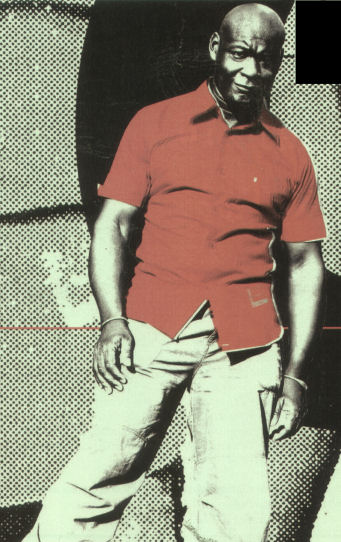 THE INFLUENCE OF DETROIT TECHNO, MUSLIM PRAYER CALLS AND THE VIBRANCY OF HIS ADOPTED CITY OF BERLIN CAN ALL BE FOUND IN ACID HOUSE PIONEER A GUY CALLED GERALD'S LATEST ALBUM. DJMAG FINDS OUT WHY IT'S HIS MOST CHILLED LONGPLAYER TO DATE. HISTORY as Tony Blair is wont to remind us will be our judge. But whereas the PM might have some, explaining to do when posterity comes calling, A Guy Called Gerald need have no such worries. For when the annals are written Gerald Simpson is sure to occupy pride of place as a genuine hero in the history of dance music. Not that you'll have much luck getting the modest Mancunian to admit it, however. "I've maybe influenced a few individuals a little bit," he says, in a clear contender for understatement of the year. "But I don't know about the course of music itself. All I've ever done is try to channel the energy of the music surrounding me into something different. When I work on a track I'm not even thinking about people playing it. My original ideas are very selfish things which I want to keep for myself – like a cook making a cake just to eat himself." But Gerald doth protest too much. For almost all of dance music's most progressive pushes over the last decade-and-a-half have had Gerald's fingerprints on them somewhere: • Exhibits A and B: 'Pacific State' and 'Voodoo Ray', recorded as a member of 808 State and as A Guy Called Gerald respectively, the two tracks which, more than any others, lit the touch paper for the British acid house explosion centred on his native Manchester in the late 1980's. • Exhibit C: his 1993 LP '28 Gun Bad Boy' - which coalesced the energy of hardcore with intricate breakbeats and techno minimalism into the first fully recognisable blueprint for drum & bass. • Exhibit D: 2000's 'Essence' LP, whose eclectic textures reconciled Gerald's dancefloor roots with abstract experimentalism. It's a weighty pile of evidence for sure, and one to which we can add his new LP 'To All Things What They Need', another magnum opus which - wandering through electronica, broken beat and techno as it does - once again proves that Gerald is impossible to pin down. "I'm not interested in making another 'Voodoo Ray' or 'Essence'," he explains. "The only common trait in my music is the desire to always do something different. That and the fact that I tend to go overboard on the bass! That comes from growing up in a household surrounded by reggae - I just love swimming in bass. "When I first got into house it was really gritty and mechanical but towards the: mid-9osit became too safe so I had to duck out of it. Which is why '28 Gun Bad Boy' happened because I needed the energy of the underground, and breakbeats were exciting me. You have one category of people whose goal is to make money and another of people who are basically adventurous and like to create sounds without a set formula. I haven't got the focus to say 'OK - this track will make this position in the charts if I put this bassline in at this level'." TECHNOPHILE However, whilst all of Gerald's previous LPs were genuinely groundbreaking, 'To All Things What They Need' sounds less like a step into uncharted territory than before. Not that it's lazy or outdated - far from it in fact, as tracks like 'Tajeen' and 'Meaning', with their elaborate percussive programming, are clearly still the work of a man in love with the possibilities of electronic sound. But at other moments the atmosphere is less coldly futuristic than warmly nostalgic - especially on 'First Try', which comes soaked in melancholic strings and a 4/4 rhythm reminiscent of vintage Detroit. Always an avowed technophile determined to push his equipment to its limits, Gerald ascribes the sound of his new LP to the fact that technology has now evolved to such a level that even the most intrepid sonic explorer is hard-pushed finding new boundaries to break. "It's definitely my most chilled-out LP,' Gerald says. "With all the LPs beforehand I've been trying to push the technology. Ever since I was working with a 303 the machinery has always provided the personality of the music. But now I feel that technology has moved on so much that the influence from the machines has gone because if you've got the skill you can make any sound you want or can imagine. For 'First Try' I spent some time imitating some of my old machines from the Detroit era which is why it came out sounding like that." So rather than fixing his gaze on the future, 'To All Things What They Need' is more the sound of Gerald looking around and taking stock of where he is today. Currently residing in Berlin, Gerald is enthused about the sounds he is absorbing in a city which - as home to labels like Kanzleramt and City Centre Offices - is emerging as a hotbed of cutting-edge talent. There's a vibrancy in the air which Gerald likens to the second summer of love in Manchester or the birth of techno in his beloved Detroit. "If you live in a city you take on the energy and spirit of that environment so people who live in places where there's a lot of machinery absorb mechanical sounds and it becomes a part of what you are," he believes. "It's a spiritual and biological thing. Detroit techno was always soul music to me and now a lot of the younger generation in Germany are rediscovering that original sound and getting as excited about it as I was." BUGGING Yet darker forces have also shaped the LP, for before moving to Berlin Gerald called New York home and what he witnessed there - before, during and after 9/11 - has clearly left its mark. "When I started doing the LP it was really inspired by being a fly-on-the-wall to all this madness," he elaborates. "Before I lived there I thought that Malcolm X and Martin Luther King had had at least some influence and that there was some equality. But there's nothing and when you're a foreigner there you start thinking that there's something seriously wrong with the place. By the time 9/11 happened I was already convinced that they were reading my mail and bugging my phone." But whilst a disquieting ambience pervades tracks like 'American Cars' – whose seemingly serene beatlessness hides darker depths – or 'Millennium Sanhedrin' – where Philadelphia poetess Ursula Rucker intones an ominous invitation to "The apocalypse party/ at Sodom and Gomorrah" – the album is ultimately a redemptive experience. It's best expressed in 'Call For Prayer' where a muezzin wail is intertwined around an ethereal electronic echo equally as haunting as the vocals. "I'm not a religious person but I thought someone should do something with the call to prayer in it because Muslims seem to be having a hard time of it at the moment. If Christians were being attacked in the same way then I'd probably do a track with Gregorian chants! But the album was intended as spiritual therapy, which is why it sounds so soft and mellow. With all the hurt and anger in the world the answer isn't to try and multiply it with more of the same but to go the other way and try and create a balance." His latest album tips the scales in Gerald's favour once again. 'To All Things What They Need' is out 31st January on K7. [Author: Paul Clarke] |
|