
Report on a Double Blind Crossover Field Trial
of the effectiveness of the TECNO AO ANTENNA DEVICE
conducted at The Southampton and SW Hants Health Authority Head Office by Professor Derek Clements-Croome of Reading University and John Jukes an Ergonomic & Environmental Consultant
June 1999
TECNO AO STUDY - PRELIMINARY REPORT
Introduction
A double blind crossover field trial of the Tecno AO antenna device has been carried out at the Head Offices of the Southampton and South West Hants Health Authority under the supervision of Professor Clements-Croome of Reading University. The purpose of the trial was to test the claims of the manufacturers that the device provides protection from the harmful effects of low frequency magnetic fields.
There is a body of scientific opinion that Extra Low Frequency magnetic fields emitted by VDU's and other electrical and electronic equipment are so slight that they can have no effect on the body . This is the official view of the Health and Safety Executive and the National Radiological Protection Board. The Tecno AO manufacturers have provided enough convincing scientific laboratory evidence to indicate a contra view that such fields, even at low field strengths can have a harmful effect on the body.
This study is designed to assess the effect of the Tecno AO in a working office environment.
Methodology
The method of assessing the effect is using an adaptation of an environmental symptom scoring system that has been widely used in a number of studies during the last ten years. The system has been developed by John Jukes an Ergonomic & Environmental Consultant and Professor Derek Clements-Croome of Reading University as part of a project to develop an international standard method of comparing the effect of building environments on productivity and health. The system has been widely used during the last four years to assess a variety of methods of improving the health of office workers.
The symptoms include the generally accepted environmental health symptoms also known as Sick Building Syndrome symptoms. In addition are the five ergonomic stress symptoms and the four symptoms associated with general stress. They are as follows:
1. Environmental Stress Symptoms - headaches; coughs/sneezes; dry, itchy, tired eyes; blocked or runny nose; tiredness/fatigue; itches, dry skin; cold or flu symptoms; dry throat; sore throat; breathing difficulties.
2. Ergonomic Stress Symptoms - lower back pain; shoulder pain; neck pain; arm & elbow pain;
3. General Stress Symptoms - irritable/tense; depressed/pessimistic; concentration problems; short term memory problems.
This gives a total of nineteen symptoms. The scoring system basically is to take the average number of symptoms per person experienced by a group in any one two or four week period. The score can be adjusted for the composition of the group by age, sex and time of year. Additional sensitivity can be built in for changes in intens ity and frequency of symptoms. For this study it was decided to use the raw scores since what was being looked for were significant changes in symptom patterns.
There have been three previous small scale studies to measure the effects of the Tecno AO. These were not double blind studies and showed positive results, which were greater than our expectations. It was therefore decided that a larger scale double blind trial was needed to confirm the results.
The Tecno AO Antenna
This device has been developed by a group of biophysicists in France and has been the subject of intensive laboratory testing during the last four years. It is based on the principle that it is possible to demonstrate that low frequency magnetic fields do have a harmful effect on living cells. They do this by inducing small circulating currents in the body which can mimic and confuse the body's own bio electrical functions. This affects the cell division process and lowers the efficiency of the immune system.
It is not practical to shield from the effects of low frequency fields with wavelengths that are several thousand miles long. The alternative is to reinforce the body's resistance to their effects. It is the electronic version of taking vitamin C to combat external infection. The device contains a saturated crystalline solution that emits a signal in the Alpha brain wavelength of around 12 cycles per second. This acts like a tuning fork and reinforces the body\rquote s own alpha rhythm which is the repair frequency used by the body's immune system.
The device is fitted to the side of each VDU and is powered by the fields generated by the VDU. A device for mobile phones performs a similar function.
The Southampton Area Health Authority Head Office is located in a suburban environment on the outskirts of Southampton. It is a well furnished conventional modern office building three stories high. It comprises two wings in the shape of a letter T which points roughly north.
The study covered some 100 staff and management divided roughly equally between the two wings. The accommodation is a mixture of enclosed offices, single and multiple occupancy and open plan. All staff have networked PC's on a minimum of one per desk. The overall design is probably similar to most modern offices in this country. The only unusual feature is that it was build without air conditioning.
The study was carried out in three stages. They were:
Stage 1 - A symptom analysis was carried out on approximately 80% of the staff at the end of March to provide a base line. The study was conducted by the analyst filling in the questionnaire by direct face to face interview. Staff were told what the antenna was and what it was designed to do. They were advised that neither they nor we knew whether their antenna was live or dummy.
Two sets of antennae were fitted to all the VDU's in each wing, each had a different colour code. One set of antennae were dummies and the other were live. Neither the staff nor the analysts knew which was which.
Stage 2 - At the end of April another symptom study was conducted and the two groups of antenna were changed over. Whichever group had the live now had the dummy and vice versa.
Stage 3 - At the end of May the third set of symptom readings was taken.
There were four analysts used, one for each floor of each wing. As far as possible the same analysts were used each time. The analysts were not advised of the half time results. They were not encouraged to second guess which antenna was which from their individual analysis sheets. Each person was asked whether they had experienced each symptom during the last four weeks and a simple yes or no answer was noted. Any comments were also noted. Assurance was given that the information concerning individual answers was confidential. The analysts are trained to ask the questions in a neutral manner with no indication of the expected response.
The method of direct interview means that the respondent has no time to think about their reply or to discuss it with other members of their working group. The result is considered to be as accurate as possible.
The Results
The results are summarised in a set of graphs below and compare the results obtained from the two wings.
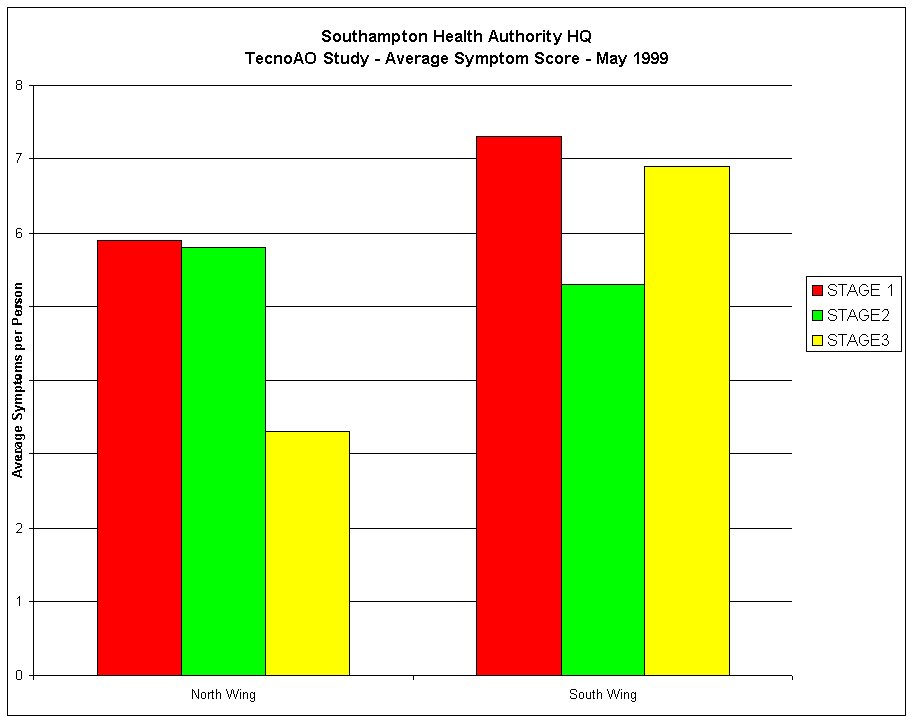
1. Average Symptom Score - This shows that the staff in the North Wing had an average symptom score of just under 6 symptoms per person during stages one and two and just over 3 symptoms per person for stage three.
The South Wing Staff have a higher symptom score of just over 7 symptoms per person and show a reduction to just over 5 in stage two and a return to just under 7 in stage 3.
The variation in symptom score is quite normal and is usually a combination of the variations in the building environment, nature of the work, and the age and sex of the population. Younger women for instance tend to have a higher symptom score than younger men.
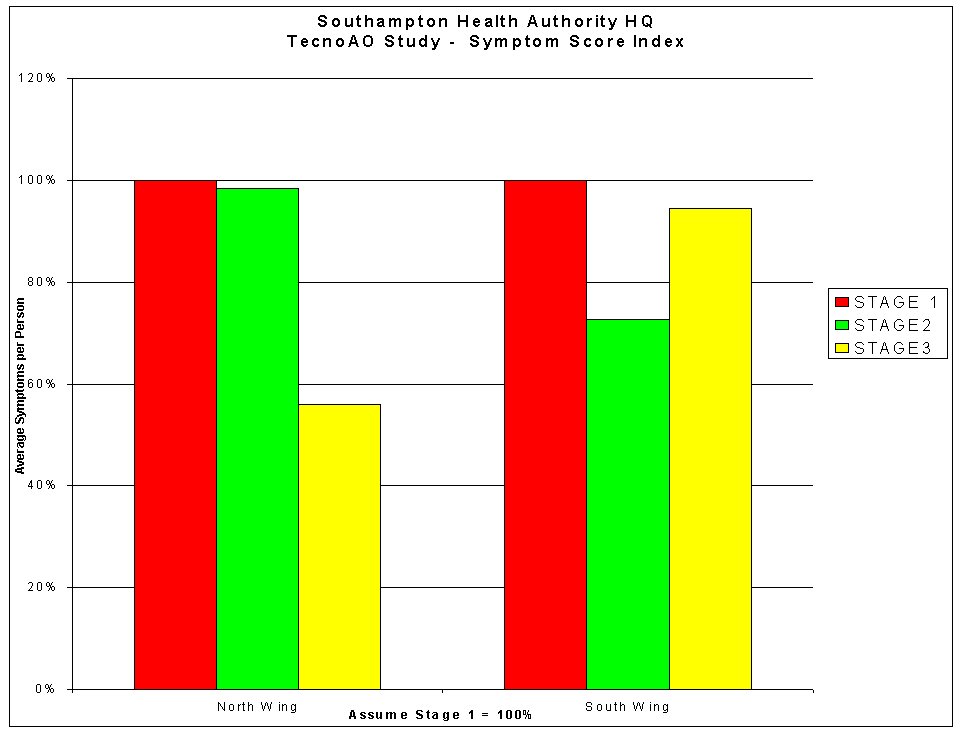
2. Symptom Score Index - This is the same information as above with the symptom score for stage one for both North and South Wings assumed to be 100.
This shows that the North Wing symptom score reduced by 45% in stage three. The South Wing symptom score reduced by 27% in stage two and reduced to just under 5% in stage three.
These results coincide with the symptom reduction range of 25-45% in the earlier smaller scale studies.
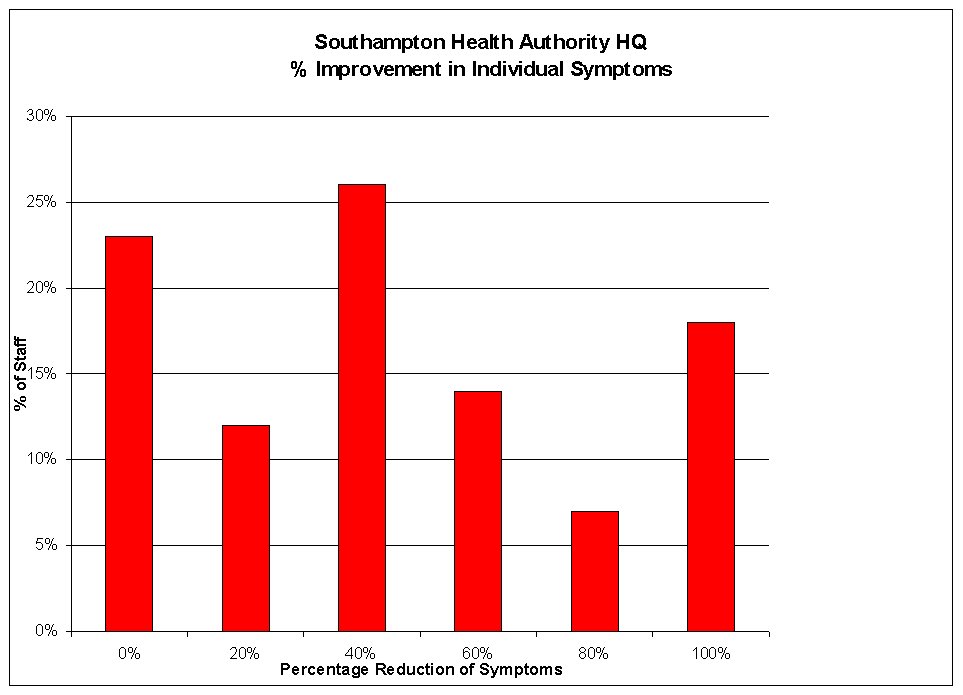
3. Percentage Improvement of Individual Symptoms -These results show that 23% of staff showed no reduction in symptoms; 40% of staff showed over 25% reduction in symptoms and 17% of staff showed a 100% reduction in symptoms.
These results coincide with other findings that some 25% of the average population are not electrically sensitive and 25% are sensitive with the rest of the population divided between the two extremes.
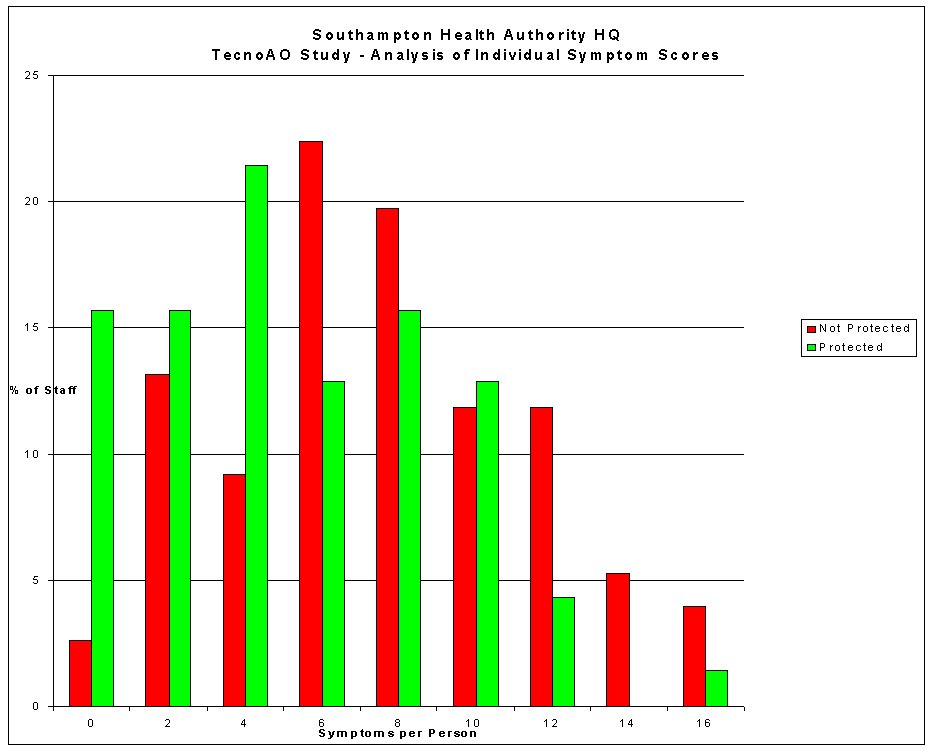
4. Analysis of Individual Symptom Scores - This shows the distribution of individual symptom scores and shows the combined reduction in symptom scores for both wings from an average of 6.6 symptoms per person to 4.3, a reduction of some 36%.. It shows a significant reduction in the high symptom scores i. e. 12-16 per person and an increase in the lower scores of 0-4 symptoms per person.
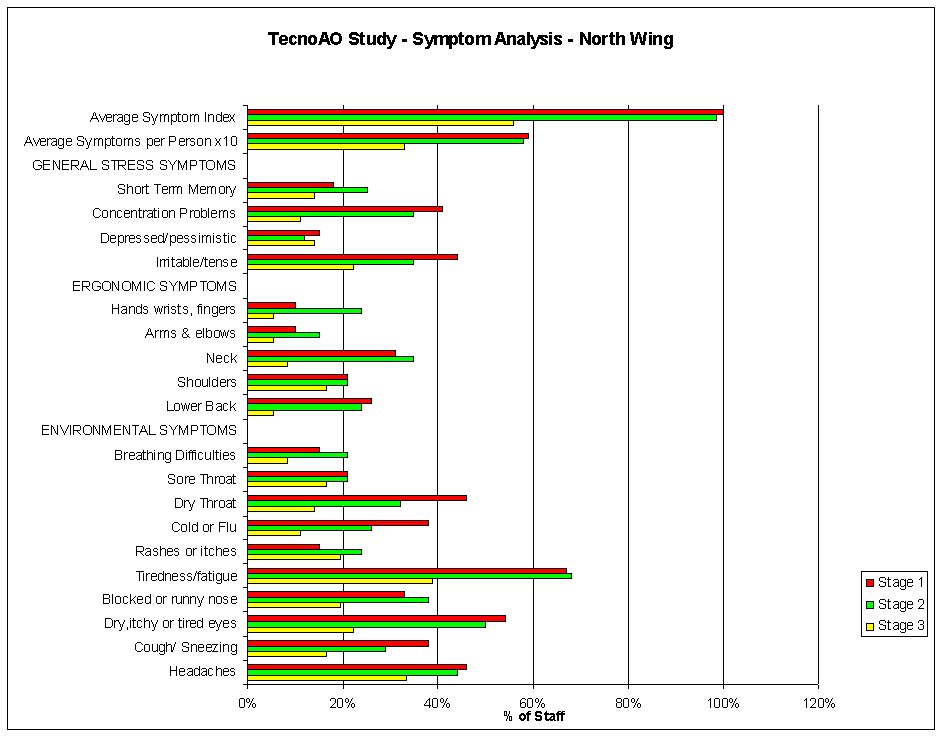
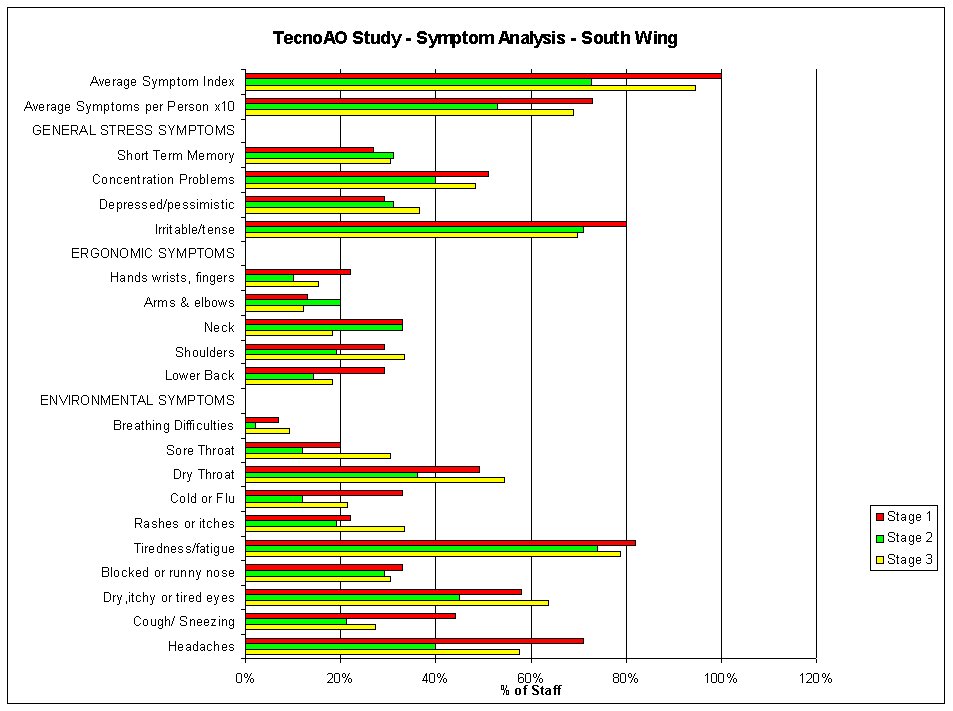
5. Symptom Analysis - North & South Wings - The basic similarities and differences between these two graphs relate to the fact that in Stage 2 the North Wing had the dummy Tecno AO antennae and the South Wing had the live antennae. In stage 3 the antennae were changed over and the situation reversed.
The relative pattern of the responses is similar for both wings except that the south wing has a higher percentage of staff experiencing each of the symptoms.
The possible reasons for the difference in symptom levels are either a greater sensitivity in the sample group or higher levels of other forms of stress. Some examples are as follows:
1. Higher percentage of younger female staff in the South Wing. This group does seem to be more sensitive and have higher symptoms scores.
2. Higher levels of thermal stress. - In the absence of air conditioning the South Wing will be subject to higher levels of solar gain on sunny days on both long sides of the building.
3. Higher levels of deadlines and job stress. - Many staff indicated that they felt under pressure arising from the new NHS organisation changes.
4. External airborne pollution. - The South Wing has one long side facing the prevailing westerly winds which with open windows would make it more vulnerable to external airborne pollution.
The detailed results are of great potential value for further investigation.
Conclusions
The study shows a significant reduction in average symptoms (between 27% and 44% with an average of 36% for those staff with a live Tecno AO antenna.) This coincides with the results of other smaller scale studies.
These results confirm that exposure to low frequency magnetic fields in offices can account for at least a third of the environmental health symptoms experienced by staff.
It indicates that the official attitude of the NRPB and the HSE which states that ELF fields can have no harmful effect on the body, needs revision. More importantly it does indicate that there is a practical solution to the problem.
The effect of low frequency magnetic fields has been long suspected and now provides the missing link to solving environmental health problems. When combined with other potential improvements in the office environment, it indicates the possibility of eliminating the problem of environmental health symptoms altogether. (There is in fact one office building in London where it is claimed that some staff complain that they get sick when they go home. Perhaps this an example of Well Building Syndrome instead of Sick Building Syndrome.)
Derek Clements-Croome - Professor of Construction Engineering - Reading University
John Jukes - Principal Consultant - John H Jukes & Associates
June 1999
REFERENCES
Abdou. O.A., Lorsch, H.G., (1994C.) - The Impact of the Building Indoor Environment on Occupant Productivity Part 3: Effects of Indoor /air Quality. ASHRAE Trans . 1, 100(2), pp. 902-913.
Bedford T, (1949) Air Conditioning and the Health of the Industrial Worker, J.I.H.V.E., 17, 112-146.
Bentham, P (1996) VDU Terminal Sickness. Computer Health Risks and How to Protect Yourself, Jon Carpenter Publishing, Oxford
Best, S., (1998) Tecno AO research at BEMS, Electromagnetic Hazard & Therapy, Vol 9, 1-2, 5
BOSTI, (1982) The Impact of the Office Environment on Productivity and the Quality of Working Life. Buffalo, NY; Westinghouse Furniture Systems.
Brundrett, G. (1994) Health and the Built Environment, Renewable Energy, 5, Prt 1, 967-973
Burge, S.A., et al, (1987) }Sick Building Syndrome: A Study of 4373 Office Workers, Am. Occ. Hygiene, 31, 493-504.
Clements-Croome, D.J., Kalaruachchi Y., Li B., (1997) What do we mean by productivity, Workplace Comfort Forum, October, London, UK
Clements-Croome, D.J., Kalaruachchi, Y., (1998) An assessment of the Influence of the Indoor Environment on the Productivity of Occupants in Offices. Case studies of Richard Ellis Headquarters Building, London and Galileo UK Ltd, Maidenhead. Department of Construction Engineering and Management, University of Reading.
Coghill R., (1990) Electro Pollution. How to Protect Yourself Against It. Thornsons Publishrs Ltd, Wellingborough, Northamptonshire.
Cyfracki L., (1990) Could Upscale Ventilation Benefit Occupants and Owners Alike? Indoor Air 90, 5th International Conference Indoor air Quality and Climate, .5, 135-141 (Aurora, ON Inglewood Printing Plus).
Dorgan, C.E., et al., (1994) Productivity Link to the Indoor Environment Estimated Relative to ASHRAE 62-1989, Proceedings of Healthy buildings 1984, Budapest, 461-472.
Drake, P., (1990) Summary of Findings from the Advanced Office Design Impact Assessments, Report to Johnson Controls Inc., Milwaukee, WI.
Ellis, R., (1994) Tomorrow's Workplace. A Survey for Richard Ellis by the Harris Research Centre
Jones, P. (1995) Health and Comfort in Offices. The Architects Journal. June 8th, 33-36
Jukes. J. (1997) Optimising the Design of the Workplace for Better Productivity and Health, Workplace Comfort Forum, London, UK
Jukes, J. (1999) Causes and Cure for Sick Building Syndrome, Workstyle, No. 1, Spring Issue. 23-26.
Leaman, A., (1994) Dissatisfaction and Office Productivity, The Facilities Management Association of Australia, Annual Conference, Sydney, Australia.
Leaman, A., (1997) Probe 10. Bench Marks for Better Buildings, Building Services Journal, May issue.
Li Baizhan, (1996a) Assessing the Influence of Indoor Environment on Health, Well-Being & Productivity, Questionnaire for Environment Survey of Offices, The University of Reading, UK
Li Baizhan, (1996b) Assessment of the Influence of Indoor Environment on Job Stress and Productivity of Occupants in Offices. The University of Reading, UK.
Li B., Croome, D.J., Yao, R., (1996) Analytical Hierarchy Process Model for Assessing Priority Indoor Environmental Factors Influencing Occupants in Offices. The 7th International Conference on Indoor Air Quality and Climate, 21-26, Nagoya, Japan.
Li B., (1998) PhD Thesis Assessing the Influence of the Indoor Environment on Productivity in Offices. University of Reading
Lorsch, H.G., Ossama, A.A., (1993) The Impact of the Building Indoor Environment on Occupant Productivity, ASHRAE Trans, 99, Part 2.
Lorsch, H.G., Abdou, O.A., (1994a) The Impact of the building Indoor Environment on Occupant Productivity Part 1: Recent Studies, measures and Costs. ASHRAE Trans, 100 (2) 741-749
Lorsch, H.G., Abdou, O.A., (1994b) The Impact of the Building Indoor Environment on Occupant Productivity Part II: Effects of Temperature, ASHRAE Trans. 100(2) 895-901
Lysaught, R.I., et al, (1989) Operator Workload: comprehensive review and Evaluation of Operator Workload Methodologies (Analytical Tech Rep. 2075-3), Alexandria, VA: US Army Research Institute for Behavioural and Social Sciences
Moray, N., et al., (1979) Final report of the Experimental Psychology Group, Mental Workload: Its Theory and Measurement, ed Moray N., New York: Plenum 101-114
NEMA (1989) Lighting and Human Performance; A Review. A report sponsored by the Lighting Equipment Division of the National Electrical Manufacturers Association, Washington DC and the Lighting Research Institute, New York.
O'Donnell, R.D., Eggemeir, F.T., (1986) Workload Assessment Methodology in Handbook of Perception and Human Performance: Cognitive Processes and Human Performance, ed. Boff, K.R., et al (New York; Wiley)
Oseland, N.A. (1996) Impact of the Indoor Environment on Comfort and Productivity, Workplace Comfort Forum, London, UK
Phillps. A., Living with Electricity, Power Watch, Cambridge
Raw, G.J., (1992) Sick Building Syndrome: A Review of the Evidence on Causes and Solutions, HSE Contract Research Report No. 42/1992
Raw, G.J., Roys, M.S., Leaman, A., (1994) Further Findings from Office Environment Survey, Part 1; Productivity, Building Research Establishment. Note No. N79/89
Salvendy, G., (1997) Handbook of Human Factors and Ergonomics, Chapter 37, Decision Making by Lehto see Section 37.3.42 page 1225 (Wiley Interscience)
Selye, H., (1978) The Stress of Life, McGraw-Hill
Silk, A. C. (1998) EMF Research on Eye Function reveals effects from VDU's and on Contact Lenses, Electromagnetic Hazard and Therapy, Vol 9, 1-2, 8-9
Silk, A. C. (1999) Mobile Phones and Human Exposure Optometry Today, April 22
Sutermeister, R.A., (1976) People and Productivity, McGraw Hill Book Company, USA
Wallach, C (1983) The Ion Controversy. A Scientific Appraisal, Bell Lumiere Pty Ltd, Australia
Wilkins, A.J., (1993) Health and Efficiency, Energy, 18, (2) 123-129
Wilson S, Hedge A., (1987) The Office Environment Survey, Building Use Studies Ltd., London.
Woods, J.E., (1989) Problem Buildings Associated Illness and the Sick Building Syndrome, 753-770 (Philadelphia: Hanley & Belfus)
Wynon, D.P., (1992) Healthy Buildings, Barriers to Productivity, Building Services Journal, June issue.
Wyon, D.P., (1993) The Economic Benefits of a Healthy Indoor Environment. Proceedings of Healthy Air 94, Budapest, 405-416.
| The Tecno AO VDU Antenna | The "Tecno Bug" for mobile phones | Home |
| How the "Bug" works | Scientific Studies | Contact Us |

©Tecno AO (UK) Ltd March1999